
The order of a session
- Tone work: long bows on open strings, even from frog to tip, to warm up the bow arm and the ear
- A scale in a key you are learning, slowly, then in rhythms
- Technique: focus on one challenge, such as a new position, bow stroke or rhythm
- A review: what you learnt last week, so it stays
- Music: a tune, a study or your piece, played through
Sample routines
| Length | What goes in |
|---|---|
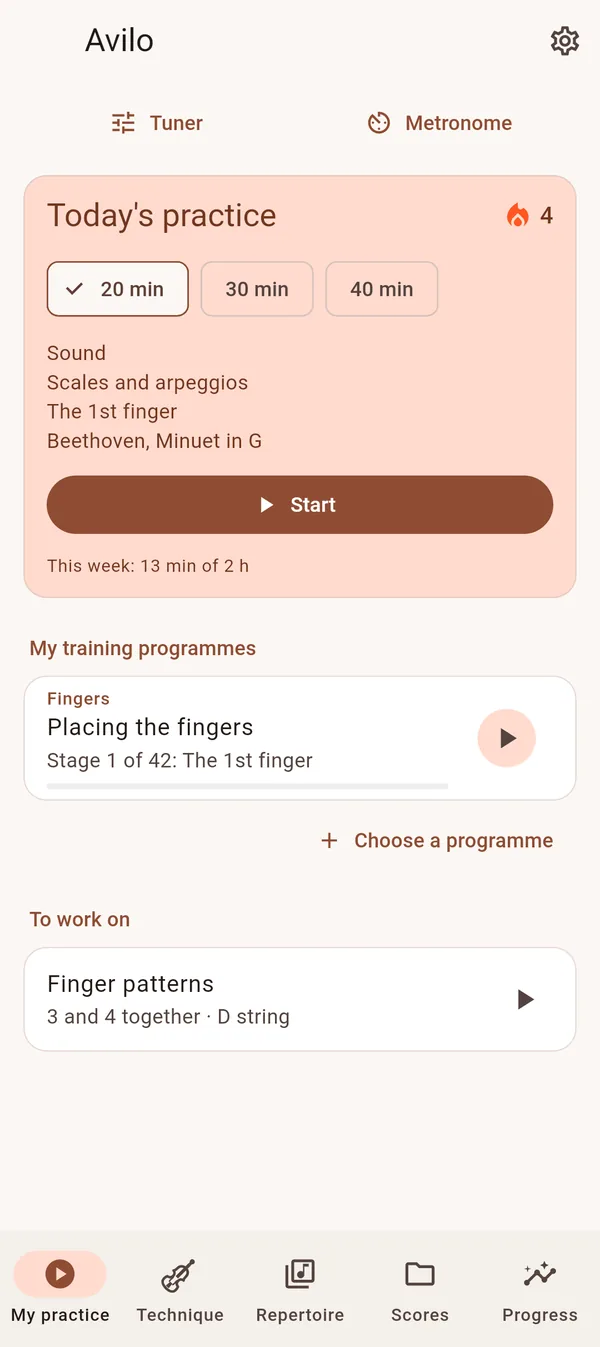
| 20 minutes | Sound 3 min, scale 4 min, new skill 8 min, music 5 min |
| 30 minutes | Sound 4 min, scale 5 min, new skill 10 min, review 4 min, music 7 min |
| 40 minutes | Sound 5 min, scale 6 min, two skills 15 min, review 5 min, music 9 min |
Twenty minutes every day are better than two hours on Sunday.
One difficulty per exercise
When an exercise combines too many unfamiliar skills, it is hard to tell what is holding you back. Choose one challenge and simplify the rest. Try a rhythm on open strings, for example, before adding the left hand.
Slow, then faster
Begin a new exercise at a comfortable tempo and increase it after a successful set. In Avilo, beginners start at 70% of the target tempo and intermediate players at 85%, then gradually build up.
Review, and come back to what went wrong
Revisit recent work every few days to help it stick. If an exercise was difficult, include it in your next session while you still remember what needs attention.
Practise quietly
A practice mute can make playing quieter when you share a home or practise late. It changes the sound considerably, so include some practice without it to hear and develop your tone.